

 English
 中文简体
 русский
 Español
 عربى

Submit feedback
How Soft Is Silicone? Shore A Durometer and Hose Flexibility Explaine
Industry news-Content
Ask a room full of people how soft silicone is and you will get a room full of answers. That is because silicone is not a single material with a single feel. It is a family of rubber compounds that can be formulated, molded or extruded to be anything from jelly-soft to firm enough to stand on its own edge. A silicone spatula, a phone case, a radiator hose and a medical tube are all silicone, and none of them feel remotely alike.
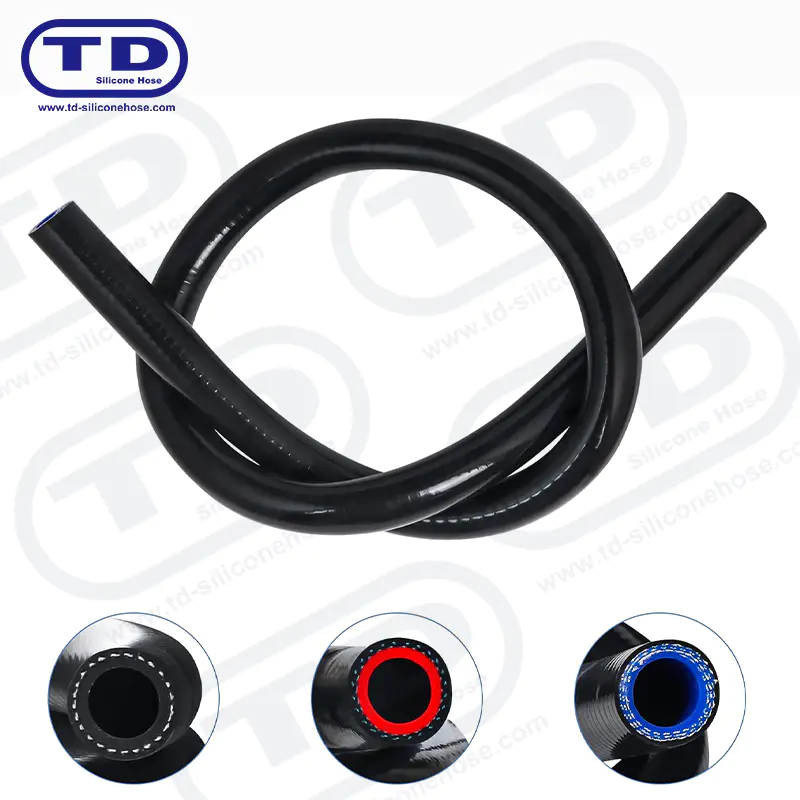
The short answer is that silicone usually measures somewhere between 10A and 80A on the Shore A hardness scale. Soft, squishy silicone sits at the low end, around 10A to 30A. The hoses we build for cooling systems, charge air and vacuum lines typically land between 50A and 70A, which feels firm and slightly tacky in your hand, gives a little under thumb pressure, and springs straight back when you let go.
But a number on a data sheet only tells part of the story. How soft a silicone part feels, and how it behaves once it is clamped onto a fitting, also depends on wall thickness, reinforcement, temperature and the way the part was made. So let us walk through it the way we talk about it on the shop floor.
What Does "Soft" Actually Mean for Silicone?
Shore A is the scale most silicone suppliers use. A spring-loaded needle is pressed into the surface of the material, and the resistance it meets becomes the reading. Lower numbers mean the needle sinks in easily; higher numbers mean the material pushes back. It is measured on a flat, clean piece of material at room temperature, which is worth remembering, because a hose sitting on a hot engine is not the same as a sample sitting on a bench.
One thing that trips people up: hardness is not the same as flexibility. A thin-walled 60A hose will bend around a corner more easily than a thick 40A block. Hardness describes how much the surface resists a point load. Flexibility describes how the whole part behaves when you bend, twist or squeeze it.
| Shore A range | What it feels like | Where you usually find it |
|---|---|---|
| 10A to 20A | Very soft, gel-like, easy to dent with a fingertip | Soft molds, cushioning pads, prosthetic skins |
| 30A to 40A | Squishy but shape-holding, similar to a pencil eraser | Gaskets, seals, light-duty flexible tubing |
| 50A to 60A | Firm rubber, gives under thumb pressure and springs back | Radiator hoses, vacuum lines, general automotive hose |
| 70A to 80A | Stiff, hard to compress by hand | Reinforced charge-air hose, wear pads, high-pressure parts |
How Soft Is Silicone Compared With Rubber?
Compared with EPDM, nitrile or natural rubber at the same durometer, silicone often feels a touch more compliant and noticeably more slippery at the surface. The bigger difference shows up with temperature. Rubber stiffens as it cools and hardens as it ages, while silicone holds its hardness across a much wider window, roughly minus 40 to 200 degrees Celsius for standard grades. A hose that feels right when you install it in a cold workshop still feels close to right after a long run.
That is one of the reasons silicone keeps showing up in cooling and intake systems. If you want a closer look at the trade-offs, we compared silicone and rubber hoses side by side in an earlier write-up.
Why Softness Matters in a Silicone Hose
In a hose, softness is a balancing act rather than a single target. Too hard, and the material will not conform to the neck it slides over, so you end up chasing a weep that never quite stops. Too soft, and the clamp can bite into the wall or the hose can flatten when the system pulls a vacuum as it cools down after a hard drive.
Take a coolant hose as an example. It has to slide over an aluminium neck, seal against it under a clamp, absorb engine movement and survive thousands of heat cycles. Every one of those jobs is easier when the compound and the wall thickness are matched to the fitting, the clamp style and the pressure the system actually sees.
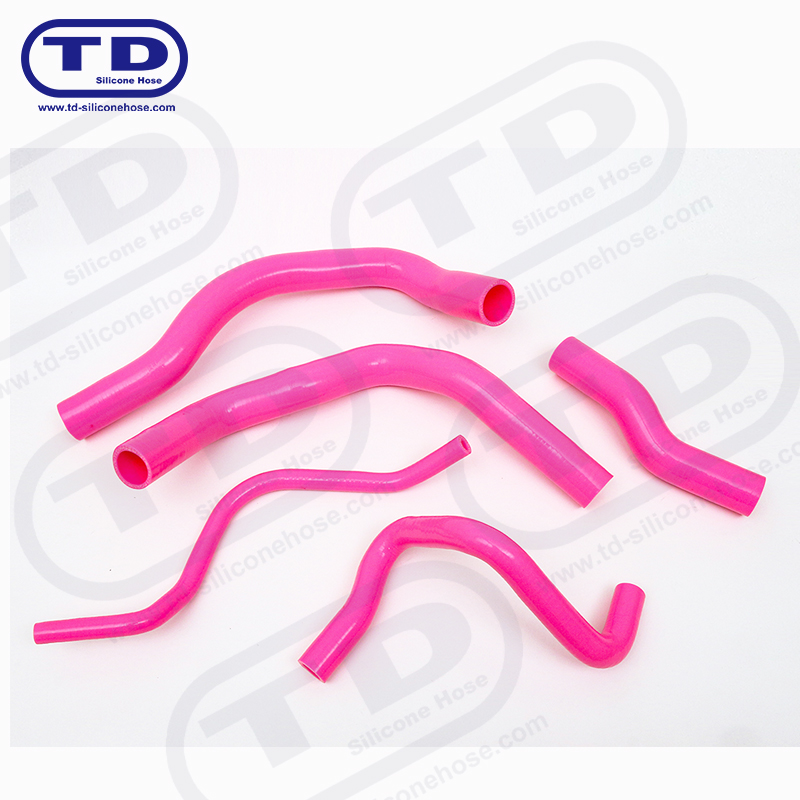 Reinforced Silicone Radiator Hose Range for Automotive CoolingView this range for coolant hoses matched to fittings, clamps and system pressure, with multi-ply reinforcement and custom configurations.View Product →
That is why a radiator hose usually feels firm rather than squishy, typically somewhere between 55A and 65A with two or three layers of polyester reinforcement buried in the wall. It is soft enough to seat on the neck and hard enough to hold its bore under vacuum.
What Changes the Softness of a Silicone Hose
Two hoses can carry the same durometer stamp and still feel completely different in your hand. These are the variables that move the needle:
- Wall thickness: a 3 mm wall and a 6 mm wall of the same compound behave nothing alike under a clamp.
- Reinforcement: polyester, aramid or wire braid inside the wall reduces how much the hose gives under pressure without changing surface hardness very much.
- Inner liner: fluorosilicone liners resist fuel, oil and solvent, and they usually feel slightly harder than the outer silicone layer.
- Temperature: silicone softens a little when hot and stiffens when cold, but far less than most organic rubbers.
- Cure and formulation: filler loading, pigment and cure time can shift the durometer by several points in either direction.
Reinforcement is the one that surprises people most. A wire-reinforced hose can read 65A on the gauge and still resist collapsing when the system pulls vacuum, because the spiral wire carries the load while the silicone does the sealing. That combination is why reinforced constructions turn up in charge-air circuits and in any line that has to hold shape under suction.
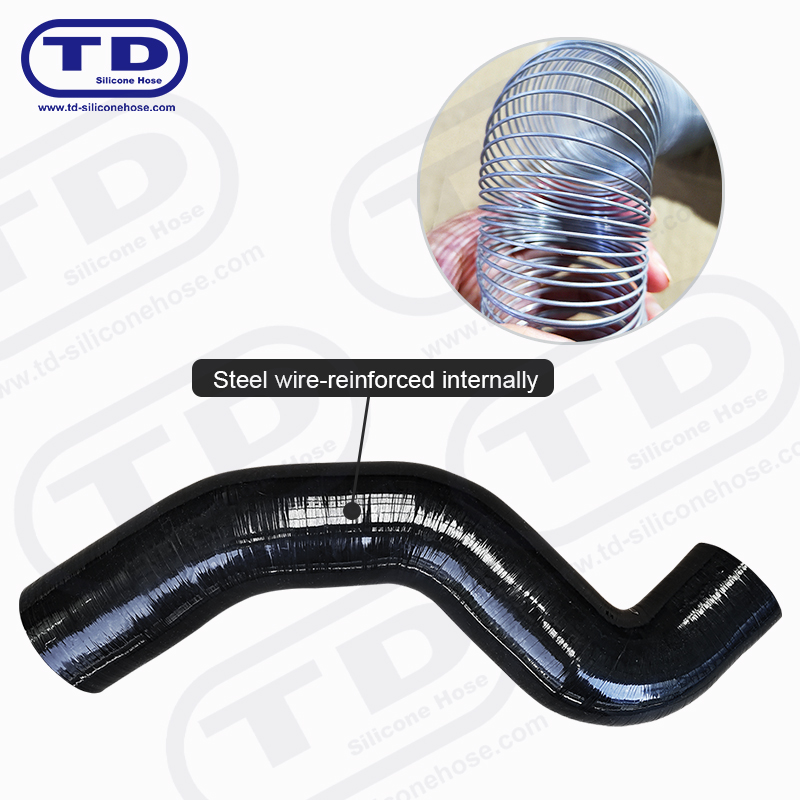 Wire Reinforced Silicone Hose for Pressure and Vacuum LinesCheck this wire-reinforced hose series for charge-air, vacuum and suction lines where the steel helix supports shape and pressure while silicone seals.View Product →
Matching Softness to the Job
There is no universal "correct" softness, only a correct softness for a given duty. The table below is a practical starting point we use when a customer describes an application over the phone.
| Application | What you want from the hose | Typical feel |
|---|---|---|
| Radiator or heater hose | Conform to the neck, resist vacuum collapse | 55A to 65A, firm but flexible |
| Charge air cooler hose | Hold boost pressure, resist ballooning | 60A to 75A, stiff, often four-ply |
| Vacuum hose | Seal tightly on small fittings | 50A to 60A, thin wall, very pliable |
| Fuel cell cooling line | Low extractables, stable at temperature | 55A to 70A, smooth bore |
| Tight-radius elbow | Hold shape through a bend | 55A to 70A, molded and reinforced |
Bends deserve a note of their own. When a route turns a corner in a crowded engine bay, a molded elbow does a job a straight length cannot. It keeps its shape under vacuum, avoids the kink you would get from forcing a straight hose around a tight radius, and the softness is tuned so the part still slides onto both fittings without a fight.
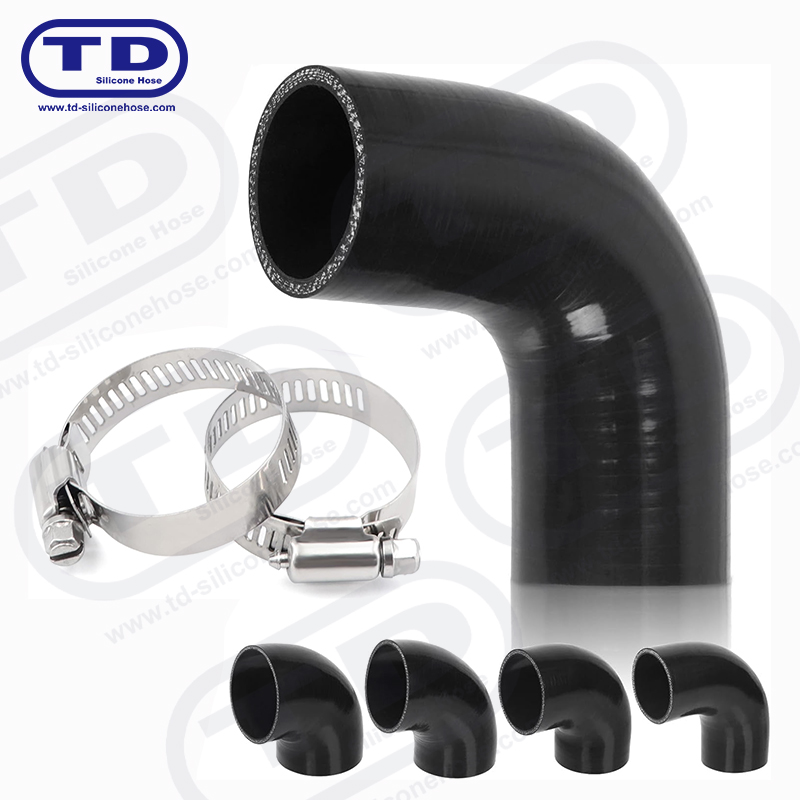 Molded Silicone 90° Elbow Hose for Tight Engine BaysView this molded right-angle hose for confined coolant, charge-air and fuel-cell routes that need a fixed bend without kinking.View Product →
How We Approach Softness on the Shop Floor
We have been making silicone hose in Ningbo for customers who build, modify and repair vehicles, and the softness conversation comes up almost every day. Our range covers nine product families and more than 1,500 items, from straight and reducer hose through 45, 90, 135 and 180 degree elbows to hump hoses, vacuum lines, clamps, aluminium fittings and a dedicated line for hydrogen fuel cell cooling and gas circuits. Production runs under an IATF 16949 quality system.
In practice, we check durometer on production batches, but we also put the part in our hands and on a fitting. A gauge tells you the surface reading; your fingers tell you whether the wall will seat, whether the clamp will bite, and whether the hose will still be round after a few hundred heat cycles. When a customer is unsure, we usually send a sample of two or three hardness options and let them try the fit on the actual neck before anything goes into a mold.
Softness is also a service-life question. A hose that is too hard for its fitting tends to leak at the joint long before the material itself fails, and a hose that is too soft for its clamp tends to fail at the cut edge. Getting the number right at the start saves a lot of roadside diagnostics later.
So how soft is silicone? Soft enough at 10A to mold around a fingertip, firm enough at 70A to hold boost pressure without ballooning, and adjustable everywhere in between. If you are choosing a hose, start with the duty rather than the number: what it clamps onto, what runs through it, how hot it gets and how tight the bend. Once those are clear, the right feel usually becomes obvious the moment you pick the part up.
If you are weighing options for a specific build, send us the fitting size, the working temperature and a photo of the routing. We are always happy to talk through which wall and which softness will keep a system sealed for the long haul.
Our Product //
Ningbo Tiandai Auto Parts Co., Ltd. All Rights Reserved. ALL RESERVED.
Wholesale Automotive Silicone Hose Manufacturers
