

 English
 中文简体
 русский
 Español
 عربى

Submit feedback
how to shape silicone hose: Applications, Selection Criteria, and Practical Guidance
Industry news-Content
Silicone hose has earned its place in modern engine bays and workshops. It handles heat, resists ozone, and stays flexible far longer than traditional rubber. But ask anyone who has tried to route a straight length around a tight corner, and you will hear the same complaint: silicone does not like being reshaped. Push it too hard, and it springs back, kinks, or both.
Knowing how to shape silicone hose properly makes the difference between a clean installation and one that leaks or fails early. In this guide, we share methods our factory uses when prototyping custom coolant and charge-air layouts, from heat-assisted bending to internal supports, so you can get the route you want without compromising the hose.
Why Silicone Hose Resists Shaping
Silicone is a thermoset elastomer. Once it is cured, heat will not melt or permanently soften it the way it would a thermoplastic. That is excellent for under-hood durability, but it means a silicone hose will not hold a bend you simply force into it. The material returns to its original relaxed state.
The same strength works against a careless bend. When you fold a hose too sharply, the inner radius becomes a stress point. Over time, that crease can split, especially under pressure and temperature cycling. Shaping silicone successfully is not about overpowering the material; it is about working with its limits and keeping the inner curve smooth.
What You Need Before You Start
Good preparation solves most shaping problems before they appear. Here is what we keep nearby when planning a custom route:
- A heat gun or a small oven for heat-assisted bends
- A coil spring or soft copper tubing to act as a support
- A sharp blade or silicone hose cutter for square cuts
- Marking chalk or a fine-tip marker for bend points
- Soapy water or silicone-compatible lubricant for sliding supports
Check the hose diameter and wall thickness before you begin. Thicker walls hold a bend better but need more heat, while thin-wall hose kinks easily and benefits from an internal spring.
Heat-Assisted Bending
The most direct way to shape silicone hose is to warm it. Silicone softens noticeably around 120-150°C (250-300°F), well below the point where it could be damaged. At that temperature it becomes pliable enough to form a gentle curve.
The Oven Method
For a clean bend, place the hose in an oven preheated to about 150°C for five to ten minutes, depending on wall thickness. Once soft, remove it, bend slowly and evenly to the desired angle, and hold it there until it cools. A block of foam or cardboard cut to the target angle makes it easier to hold the shape.
The Heat Gun Method
A heat gun gives more localised control. Rotate the hose under the heat, keeping the gun moving so the surface does not scorch. When the section becomes slightly tacky and easy to flex, bend it in small steps rather than one forced motion, and let the hose cool completely before releasing it.
One caution from our shop floor: do not overheat silicone. Prolonged exposure above 200°C weakens the material and leaves a chalky, degraded surface. Warm it just enough to work with.
Using an Internal Support
For long sweeping bends, or when you want to avoid heat, an internal support is the simplest answer. A coil spring made for hose bending, or even a length of soft copper tubing, holds the passage open while you shape the wall around it.
Slide the support into the hose first; a little soapy water helps it move smoothly. Then bend slowly and evenly along the marked point, keeping consistent pressure across the whole curve. The support stops the inner wall from collapsing and prevents the kink that would form at the tightest part of the radius.
Remove the spring once the bend is set. If you are working with a wire-reinforced silicone hose, the embedded spiral already provides some support, but the wall can still crease if you force a very tight radius. For more detail, see our guide on bending silicone hose without kinking.
Cutting and Joining for Complex Routes
Sometimes the cleanest shape is not a single bent hose at all. When a route has multiple changes of direction, it is often better to cut straight sections and join them with elbows, reducers, or short jumper lengths. This is standard practice when we mock up new coolant systems, and it gives three advantages: every curve has a consistent radius, the wall is never stressed by a forced bend, and a single section can be replaced without tearing out the whole line.
The key is a clean, square cut. A sharp blade gives a straight edge that seals evenly against a joiner or clamp, while a ragged cut creates a leak path. Measure twice, cut once, and always deburr the inner edge after cutting.
When to Use Pre-Formed Hoses Instead
There is a difference between shaping a hose and choosing one that is already shaped. If your route needs a tight 90-degree turn near the radiator, no amount of careful bending will match the smooth, uninterrupted curve of a factory-moulded elbow. A pre-formed bend has uniform wall thickness, no stress points, and a consistent inner radius.
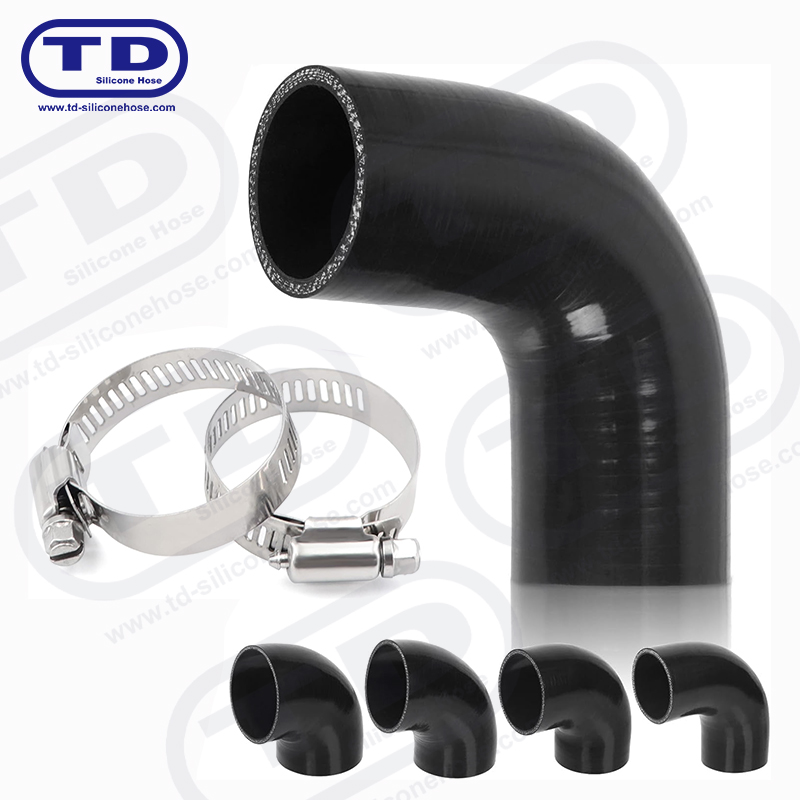 Pre-formed 90° Silicone Elbow Hose for Tight TurnsThis factory-moulded elbow avoids kinks and stress points where a tight bend is needed, making it the right choice for radiator or charge-air routes.View Product →
Likewise, if the route changes diameter, a reducer hose is the right solution rather than stretching a straight hose over a mismatched outlet. A reducer tapers smoothly and keeps the clamp area free of distortion.
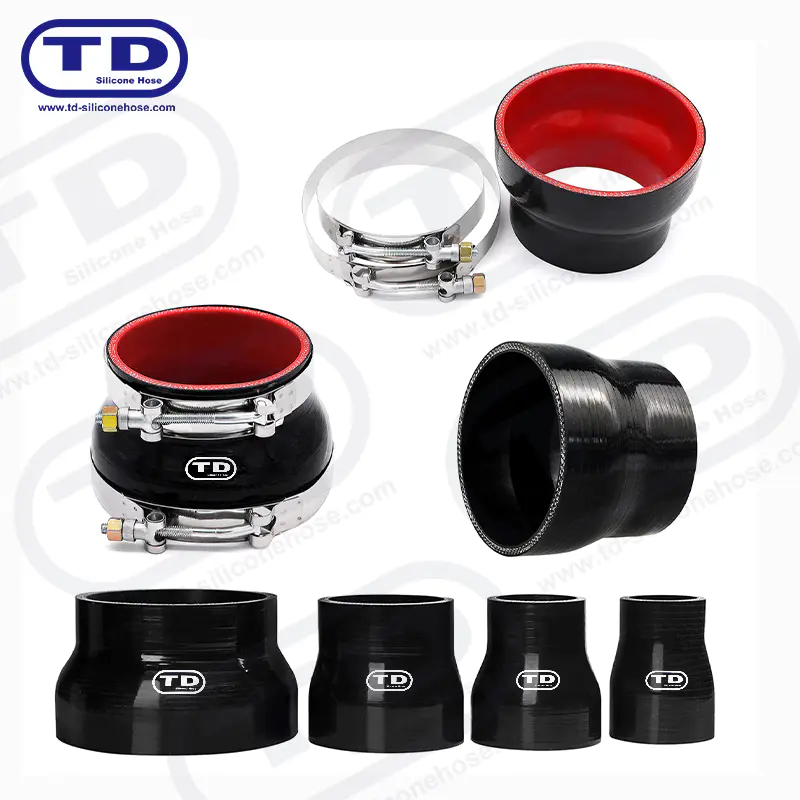 Silicone Reducer Hose Range for Diameter ChangesWhen the route changes pipe size, this tapered reducer keeps the clamp area free of distortion, ideal for step-down connections in cooling and intercooler systems.View Product →
For joining two rigid components that move relative to each other, such as an engine and radiator, a hump hose absorbs vibration while keeping the connection leak-free. In these cases, shaping a straight hose works against you, and the pre-formed option is the professional choice.
 Reinforced Silicone Straight Hump CouplerThe molded bulge absorbs vibration and thermal growth between rigid components, ensuring a leak-free, movement-tolerant connection for engine and radiator joints.View Product →
Choosing the Right Shaping Method
To help you decide, here is a quick comparison of the approaches covered in this guide:
| Method | Best For | Difficulty | Kink Risk |
|---|---|---|---|
| Heat-assisted bending | Single, gentle curves on straight hose | Moderate | Low |
| Internal support | Long sweeping bends without heat | Easy | Low |
| Cut and join | Multi-direction routes | Easy | Very low |
| Pre-formed hose | Tight radii, transitions, flex joints | None | None |
Common Mistakes to Avoid
These are the mistakes we see most often, both in our factory and from the field:
- Forcing the radius. Every silicone hose has a minimum bend radius. Exceed it, and the inner wall collapses and restricts flow.
- Skipping the support. A coil spring is inexpensive and removes most of the guesswork. Use it.
- Overheating. Silicone does not need to smoke to be formable. Gentle warmth is enough.
- Releasing the bend too early. Hold the hose in place until it cools fully, or it will creep back toward straight.
- Choosing the wrong starting shape. If a factory elbow fits, use it. Bending a straight hose into a tight corner is usually a compromise.
Final Thoughts
Shaping silicone hose is a practical skill that improves with the right tools and a little patience. Warm the material gently, support the inner radius, let the bend cool, and you will get a clean route that performs like a factory part. When the geometry gets too tight, step back and pick a pre-formed elbow, reducer, or hump hose from the start.
At Ningbo Tiandai Auto Parts, we manufacture silicone hoses for cooling, heating, and charge-air systems across vehicles and machinery. If you are unsure which hose fits your project, our team understands these materials from raw compound to finished clamp. Explore our range to find the right starting point for your next installation.
Our Product //
Ningbo Tiandai Auto Parts Co., Ltd. All Rights Reserved. ALL RESERVED.
Wholesale Automotive Silicone Hose Manufacturers
