

 English
 中文简体
中文简体 русский
 Español
 عربى
عربى
Submit feedback
Silicone vs. Rubber Hoses: Which is Best, and Why Universal Silicone Hose Wins?
Industry news-Content
- 1 Material Composition: What Silicone and Rubber Hoses Are Actually Made Of
- 2 Silicone vs Rubber Hoses: Full Performance Comparison
- 3 Heat Resistance: Where the Gap Between Silicone and Rubber Is Most Significant
- 4 Fluid Compatibility: The One Area Where Rubber Still Wins
- 5 What Is a Universal Silicone Hose and When Should You Use One?
- 6 How to Measure and Select the Right Universal Silicone Hose
- 7 Installation Tips for Silicone and Rubber Hoses
- 8 Lifespan and Cost: Is the Premium for Silicone Justified?
- 9 Silicone vs Rubber Hoses: Application Decision Guide
Silicone hoses outperform rubber hoses in temperature resistance, lifespan, and dimensional stability — but rubber hoses cost 30–60% less and handle petroleum-based fluids better. For cooling systems, turbo induction, and high-heat engine applications, silicone is the clear winner. For fuel lines, oil systems, and budget repairs, rubber remains the practical choice. A universal silicone hose adds further flexibility by fitting multiple bore sizes and routing configurations, making it popular for performance builds and custom applications where an exact OEM fit is unavailable.
Material Composition: What Silicone and Rubber Hoses Are Actually Made Of
The performance differences between silicone and rubber hoses trace back directly to their base chemistry, which determines how each material responds to heat, pressure, fluid exposure, and aging.
Silicone Hoses
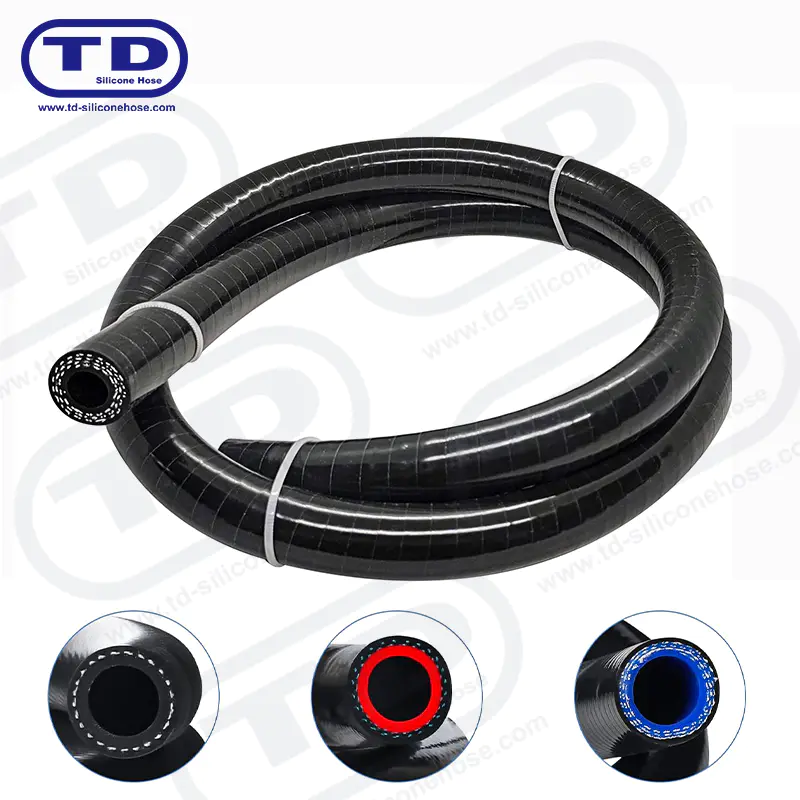
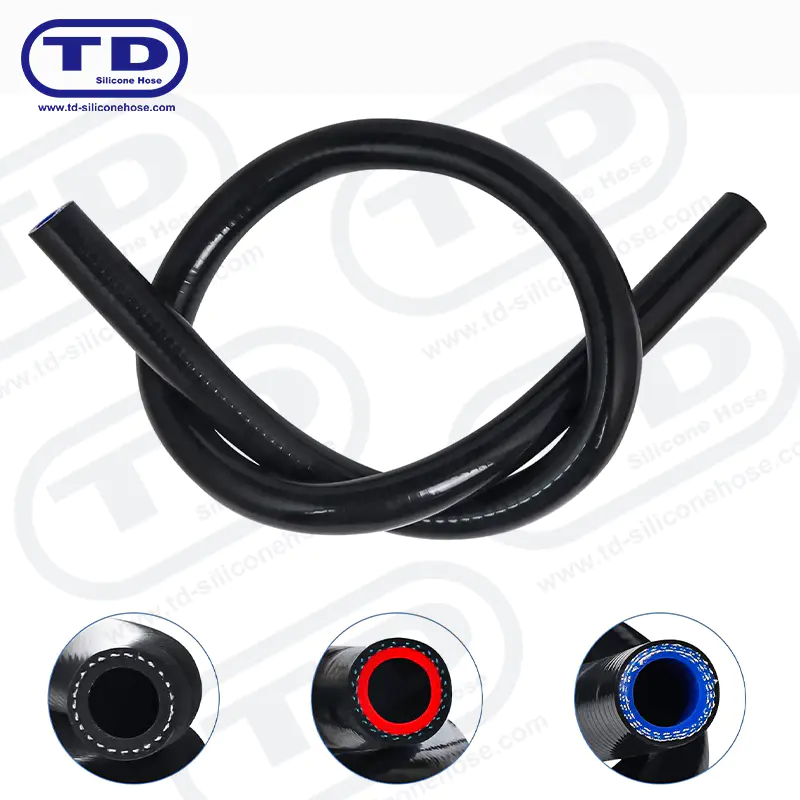
Silicone hoses are made from polydimethylsiloxane (PDMS), a synthetic polymer with silicon-oxygen backbone bonds. This inorganic backbone is far more thermally stable than the carbon-carbon bonds in organic rubber. Most automotive silicone hoses are reinforced with one to four layers of polyester or aramid braid, depending on the pressure rating. Standard silicone hose construction handles continuous temperatures from -60°C to +180°C, with some high-performance grades rated to +220°C for short durations.
Rubber Hoses
Automotive rubber hoses use either EPDM (ethylene propylene diene monomer) for cooling and water applications, or NBR (nitrile butadiene rubber) for fuel and oil lines. EPDM is the most common OEM coolant hose material, rated for continuous use up to 120°C–140°C. NBR handles petroleum products exceptionally well but has a much narrower temperature range (-40°C to +120°C). Both rubber types degrade through oxidation, ozone attack, and heat cycling — processes that silicone resists far more effectively.
Silicone vs Rubber Hoses: Full Performance Comparison
The table below compares silicone and rubber hoses across the performance criteria that matter most in automotive and industrial applications.
| Property | Silicone Hose | EPDM Rubber Hose | NBR Rubber Hose |
|---|---|---|---|
| Continuous temp. range | -60°C to +180°C | -40°C to +140°C | -40°C to +120°C |
| Typical service life | 8–15+ years | 4–8 years | 3–7 years |
| Coolant resistance | Excellent | Excellent | Moderate |
| Fuel / oil resistance | Poor | Poor | Excellent |
| Ozone / UV resistance | Excellent | Good | Moderate |
| Flexibility at low temp. | Excellent (stays soft to -60°C) | Good (stiffens below -20°C) | Moderate (stiffens below -10°C) |
| Burst pressure (typical) | 3–7 bar (varies by wall/braid) | 5–10 bar | 8–20 bar |
| Relative cost | High (2–4× rubber) | Low–Medium | Low–Medium |
| Appearance retention | Excellent (no cracking/blooming) | Moderate (surface blooms) | Moderate |
Heat Resistance: Where the Gap Between Silicone and Rubber Is Most Significant
Temperature tolerance is the single most important performance differentiator between silicone and rubber hoses in engine bay applications, and the margin is substantial.
A standard EPDM rubber coolant hose begins to harden, crack, and lose elasticity after prolonged exposure above 130°C. In a modified or turbocharged engine, underhood temperatures can regularly exceed 150°C near the exhaust manifold — well outside EPDM's safe operating zone. Silicone, by contrast, maintains its flexibility and sealing integrity at 180°C continuously, and survives brief spikes to 220°C without permanent deformation.
For turbocharged engines, performance builds, and any application where underhood heat is elevated above standard, silicone hoses are not a luxury upgrade — they are a reliability requirement. A burst coolant hose from heat-degraded EPDM in a turbo application causes immediate overheating and potential engine damage, with repair costs that dwarf the cost of a silicone hose set many times over.
Fluid Compatibility: The One Area Where Rubber Still Wins
Despite silicone's advantages in thermal performance, it has a critical limitation: standard silicone is not compatible with petroleum-based fluids including gasoline, diesel, engine oil, transmission fluid, and brake fluid. Prolonged exposure to these fluids causes silicone to swell, soften, and lose structural integrity.
This is not a minor caveat — it defines where silicone hoses must not be used:
- Fuel delivery lines: NBR or fluorosilicone (FVMQ) hoses are required. Standard silicone will swell and fail.
- Engine oil returns and vents: Use NBR or fluorocarbon (FKM/Viton) hoses. Silicone is unsuitable.
- Power steering lines: These carry hydraulic fluid under high pressure — not an application for silicone.
- Brake lines: Require EPDM or specifically FMVSS-rated brake hose — silicone is not approved for this application in most markets.
Note: fluorosilicone (FVMQ) hoses exist specifically to bridge this gap — they offer silicone's temperature range combined with fuel and oil resistance, but at a significantly higher price (typically 3–6× standard silicone). They are used in aerospace and specialized motorsport applications where no compromise is acceptable.
What Is a Universal Silicone Hose and When Should You Use One?
A universal silicone hose is a straight, elbow, or reducer silicone hose sold without vehicle-specific fitment — designed to be trimmed, routed, or adapted to fit a range of bore sizes and configurations rather than replacing a single OEM part exactly.
Common Universal Silicone Hose Formats
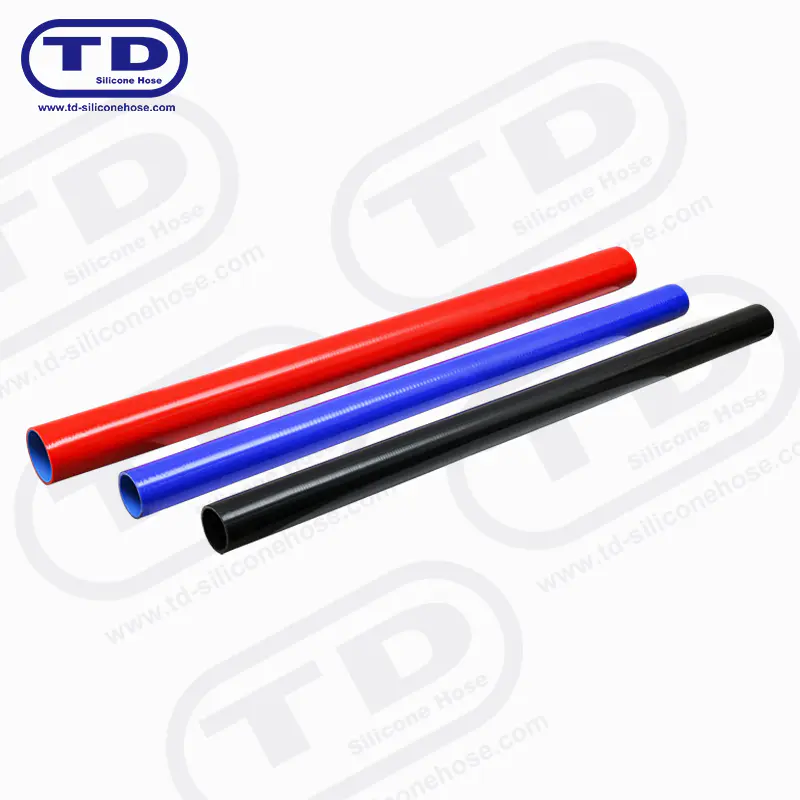
- Straight hoses: Available in lengths of 300–1,000 mm and bore sizes from 8 mm to 100 mm. Trimmed to exact length at installation. Used for intercooler piping, turbo outlet connections, and radiator hose replacements on custom builds.
- Elbow hoses (45°, 90°, 135°): Pre-formed angles that replace complex OEM molded hoses where a matching profile hose is unavailable or discontinued. The 90° elbow is the most widely used format.
- Reducer hoses: Transition between two different bore diameters — for example, 63 mm to 57 mm — to connect mismatched turbo inlets, intercooler pipes, or throttle body fittings without fabricating custom adapters.
- Hump hoses: Feature a raised center section that allows for slight misalignment between two pipe ends — commonly used at radiator connections where the engine mounts create movement between the engine and chassis.
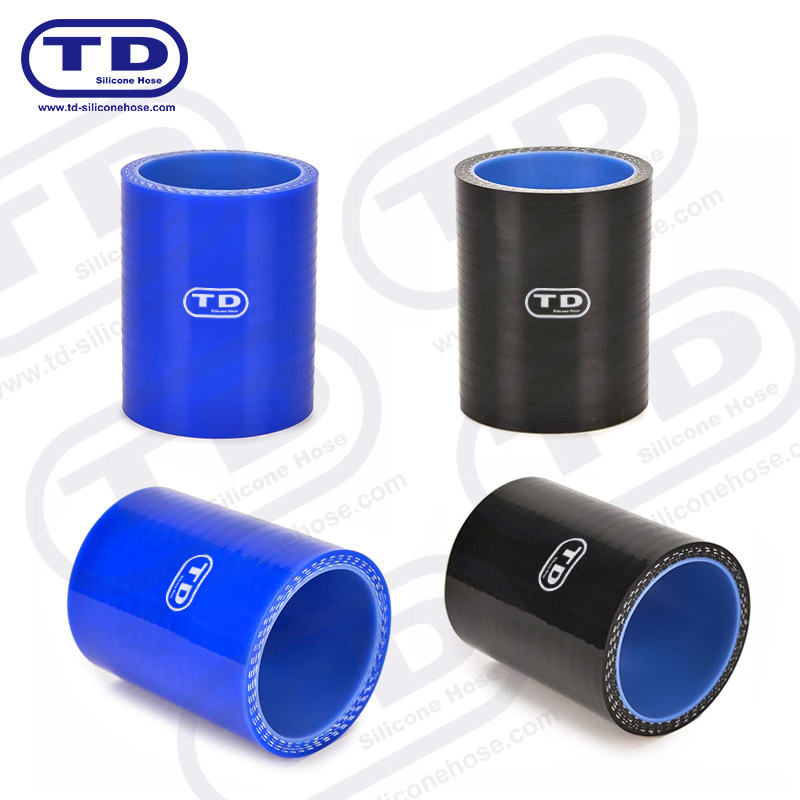
- Couplers: Short straight sections (50–100 mm long) used to join two rigid pipes. Common in intercooler pipework and turbo installations.
Best Use Cases for Universal Silicone Hoses
- Custom turbo or supercharger inlet and outlet piping where no OEM part exists
- Engine swaps where the new engine's hose routing does not match the donor vehicle's layout
- Replacing discontinued OEM molded hoses on older or rare vehicles
- Intercooler piping on performance builds where aluminum or silicone pipe sections are fabricated to a custom layout
- Industrial applications requiring flexible high-temperature connections between fixed pipe sections
How to Measure and Select the Right Universal Silicone Hose
Selecting the wrong bore size is the most common installation mistake with universal silicone hoses. Silicone hoses are sized by inside diameter (ID), which must match the outside diameter (OD) of the pipe or fitting it connects to.
- Measure the pipe OD accurately. Use calipers, not a ruler. Common automotive pipe sizes in millimeters include 19, 25, 32, 38, 45, 51, 57, 63, 70, 76, and 89 mm. A silicone hose ID should match the pipe OD as closely as possible — a 1–2 mm undersize is acceptable (the hose stretches slightly over the pipe), but oversize leads to leaks under clamp.
- Choose the correct wall thickness. Standard wall silicone hoses for coolant and induction use are typically 4–5 mm wall thickness. High-pressure applications (intercooler piping at boost pressures above 1.5 bar) benefit from 5–6 mm walls or a 4-ply reinforcement construction.
- Select the right angle. Measure the angle of the routing path before ordering an elbow. A 90° elbow is not a substitute for an 135° elbow — forcing a hose into the wrong angle introduces stress that accelerates joint failure.
- Check the ply count. Universal silicone hoses are available in 2-ply, 3-ply, and 4-ply constructions. 2-ply suits low-pressure coolant applications; 3–4-ply is recommended for turbo and intercooler use where boost pressure and vibration loads are higher.
- Confirm the temperature rating. Most universal silicone hoses are rated to 180°C continuously. For installations directly adjacent to exhaust components, specify a higher-grade hose rated to 200°C+ or add a heat shield.
Installation Tips for Silicone and Rubber Hoses
Correct installation is as important as selecting the right hose. A premium silicone hose installed incorrectly will leak or fail prematurely; a modest rubber hose installed correctly will outlast a misinstalled silicone one.
Clamp Selection and Torque
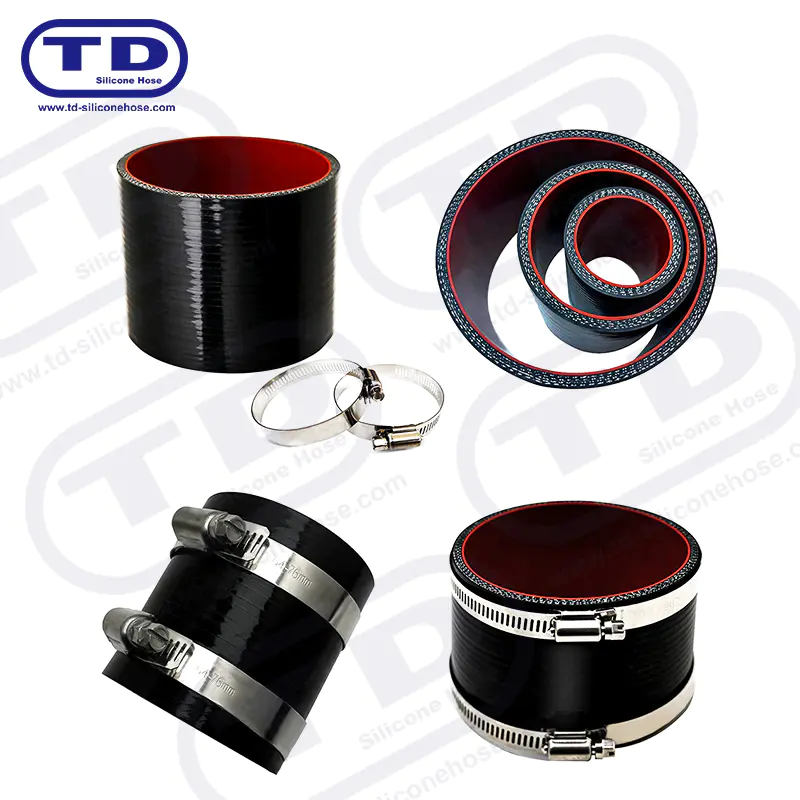
T-bolt clamps (also called T-bar or profiled clamps) are the correct choice for silicone hoses, especially on turbo and intercooler applications. Standard worm-drive hose clamps (Jubilee clips) concentrate clamping load on a narrow band, which can cut through silicone wall material under vibration. T-bolt clamps distribute force evenly around the full circumference. Recommended clamp torque for silicone hoses is typically 4–6 Nm — overtightening crushes the hose and creates weak points.
Pipe Preparation
The pipe or fitting the hose connects to must be clean, free of burrs, and have a smooth end profile. A sharp pipe edge will cut into the silicone inner wall under pressure cycling. Deburr all pipe ends and lightly chamfer the leading edge before sliding on the hose. A small amount of clean water or soap solution can be used as a fitting lubricant — never use petroleum-based lubricants on silicone hoses, as they will degrade the material.
Hose Positioning and Clearance
Route silicone hoses with a minimum 25 mm clearance from exhaust components and sharp metal edges. Where routing passes near heat sources, wrap the hose with aluminized heat sleeve rated to at least 250°C. Check that the installed hose does not kink at any bend radius tighter than 3× the hose ID — kinking reduces effective flow area and creates a stress point that fails under pressure.
Lifespan and Cost: Is the Premium for Silicone Justified?
The upfront cost difference between silicone and rubber hoses is real, but the total cost of ownership calculation often favors silicone for high-heat applications.
| Factor | EPDM Rubber Hose Set | Silicone Hose Set |
|---|---|---|
| Typical parts cost | $20–$80 | $60–$200 |
| Expected service life | 4–8 years | 10–15+ years |
| Replacements over 15 years | 2–3 times | 0–1 times |
| 15-year total parts cost (est.) | $60–$240 | $60–$200 |
| Risk of heat-related failure | Moderate–High (modified engines) | Very Low |
| Best suited for | Stock engines, budget repairs | Modified, turbo, high-heat engines |
On a stock, naturally aspirated engine operating well within normal temperature ranges, a quality EPDM rubber hose set is a perfectly sound choice and will provide reliable service at lower cost. On any turbocharged, supercharged, or heavily modified engine, silicone is worth the premium — not just for performance, but to avoid a coolant failure that can destroy an engine worth many times the cost of the hoses.
Silicone vs Rubber Hoses: Application Decision Guide
Use this guide to match the right hose material to your specific application without guesswork.
| Application | Recommended Material | Reason |
|---|---|---|
| Turbo / intercooler piping | Silicone (3–4 ply) | High heat, boost pressure, long service life |
| Coolant hoses (stock engine) | EPDM Rubber or Silicone | Both work; silicone lasts longer |
| Coolant hoses (modified engine) | Silicone | Higher underhood temps exceed EPDM limits |
| Fuel lines | NBR Rubber or Fluorosilicone | Standard silicone swells in fuel |
| Oil return / vent lines | NBR or FKM Rubber | Oil incompatible with standard silicone |
| Air induction (cold side) | Silicone or EPDM | Low pressure, ambient temperature |
| Heater hoses | Silicone (preferred) or EPDM | Close to engine; silicone handles heat better |
| Industrial high-temp transfer | Silicone | Sustained high temps, non-petroleum fluids |
Our Product //
Ningbo Tiandai Auto Parts Co., Ltd. All Rights Reserved. ALL RESERVED.
Wholesale Automotive Silicone Hose Manufacturers
