

 English
 中文简体
中文简体 русский
 Español
 عربى
عربى
Submit feedback
Why Car Manufacturers Use Silicone Hoses vs. Rubber
Industry news-Content
- 1 The Core Material Advantages of Silicone Over Rubber
- 2 Silicone vs. Rubber Hoses: A Direct Comparison
- 3 Where Car Manufacturers Specifically Choose Silicone
- 4 The Engineering Structure of Automotive Silicone Hoses
- 5 Why the Higher Cost Is Justified in Production Vehicles
- 6 Silicone Hoses in Electric and Hybrid Vehicles
- 7 Aftermarket Silicone Hose Upgrades: When They Make Sense
- 8 Limitations of Silicone Hoses Manufacturers Still Work Around
Car manufacturers use silicone hoses because they outlast standard rubber hoses by 3–5 times, withstand temperatures from -60°C to +220°C (-76°F to +428°F), and maintain consistent performance under extreme pressure and chemical exposure. Unlike EPDM or neoprene rubber, silicone does not crack, harden, or degrade over a vehicle's typical lifespan. This makes silicone the preferred material for coolant systems, turbocharger plumbing, intercooler connections, and emissions control across both OEM production lines and performance aftermarket applications.
The Core Material Advantages of Silicone Over Rubber
Silicone is a synthetic polymer built around a silicon-oxygen backbone rather than a carbon chain like natural or synthetic rubber. This fundamental molecular difference is what gives silicone hoses their superior properties in automotive environments.
Temperature Resistance
Standard EPDM rubber hoses typically operate between -40°C and +150°C. Silicone hoses extend that range to -60°C to +220°C continuously, with some reinforced grades tolerating brief spikes up to +260°C. In turbocharged engines where charge-air temperatures can exceed 180°C under boost, this difference is not marginal — it is the reason silicone is specified by default.
Aging and Hardening Resistance
Rubber hoses lose elasticity as engine oils, ozone, and heat break down their carbon-chain structure. Silicone's inorganic backbone is largely immune to ozone and UV degradation. A silicone coolant hose installed at the factory can still flex and seal correctly after 150,000–200,000 miles, whereas a rubber hose may need replacement at 60,000–80,000 miles.
Chemical Compatibility
Silicone resists swelling and degradation when exposed to coolant additives, brake fluid vapor, and diluted fuel vapors. It does have limited resistance to concentrated petroleum-based oils and fuels, which is why manufacturers select specific silicone compounds or reinforced variants for fuel-adjacent applications rather than using a single grade across all hose types.
Silicone vs. Rubber Hoses: A Direct Comparison
The table below compares silicone and standard EPDM rubber across the performance metrics most relevant to automotive hose selection:
| Property | Silicone Hose | EPDM Rubber Hose |
|---|---|---|
| Continuous Temp Range | -60°C to +220°C | -40°C to +150°C |
| Expected Service Life | 150,000–200,000+ miles | 60,000–80,000 miles |
| Ozone / UV Resistance | Excellent | Moderate |
| Flexibility at Low Temp | Remains flexible | Stiffens noticeably |
| Burst Pressure (reinforced) | Up to 250 PSI | Up to 150 PSI |
| Material Cost (relative) | 3–5× higher | Baseline |
| Weight | Slightly lighter | Standard |
Where Car Manufacturers Specifically Choose Silicone
Not every hose in a vehicle uses silicone — manufacturers select it strategically for the applications where heat, pressure, or longevity requirements exceed what rubber can reliably deliver.
Coolant and Radiator Hoses
Coolant circuits in modern engines cycle fluid at 90°C–110°C continuously, with surge temperatures near the thermostat housing often higher. Silicone maintains its seal integrity and flexibility across this entire range without the internal surface degradation that causes rubber hoses to shed particles into the cooling system. BMW, Porsche, and Audi have used silicone coolant hoses as standard equipment across multiple model lines precisely because replacement intervals become negligible.
Turbocharger and Intercooler Pipework
Compressed air exiting a turbocharger can reach temperatures of 150°C–200°C before the intercooler. The hoses connecting the turbo outlet to the intercooler and then to the intake manifold face both high heat and boost pressures typically between 10–25 PSI on production vehicles (higher on performance applications). Multi-ply reinforced silicone hoses — usually with two or three layers of polyester or aramid braid — are the standard choice here because they hold their shape under boost and resist heat-cycling fatigue that quickly destroys rubber alternatives.
Emissions and Vacuum Lines
Vacuum lines routed near exhaust manifolds and EGR (exhaust gas recirculation) systems face both heat and chemical exposure from recirculated exhaust gases. Silicone's resistance to ozone and thermal oxidation makes it substantially more reliable in this area than rubber, which can crack and cause vacuum leaks that trigger fault codes and emissions test failures.
Heater Core Hoses
Heater hoses carry coolant into the cabin heating system and are particularly prone to bending stress where they pass through firewall grommets. Silicone's flexibility at both high and low temperatures — it remains pliable at -40°C where rubber stiffens — prevents cracking at bend points during cold-weather starts.
The Engineering Structure of Automotive Silicone Hoses
A production automotive silicone hose is not simply a tube of silicone rubber. It is a layered composite engineered for a specific pressure, temperature, and bend-radius requirement.
- Inner liner: Smooth silicone bore that minimizes flow restriction and resists chemical attack from coolant or charge air
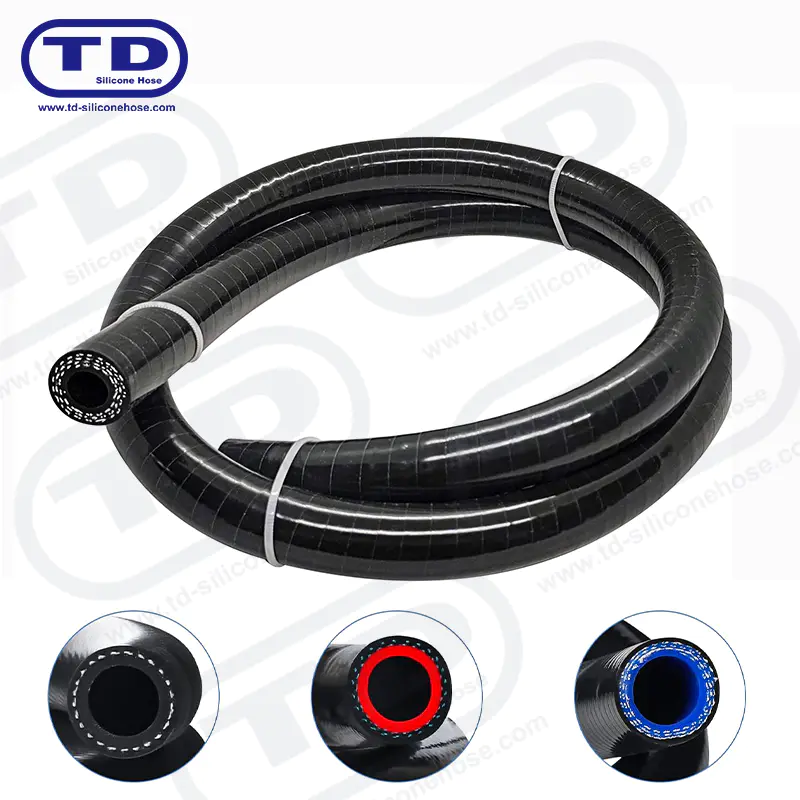
- Reinforcement plies: One to four layers of woven polyester or aramid (Kevlar-type) fabric that define burst pressure and prevent ballooning under boost
- Outer layer: UV- and abrasion-resistant silicone skin that protects reinforcement from underhood contamination
A standard 2-ply silicone hose used in production coolant systems typically has a wall thickness of 5–6 mm and a burst pressure of around 150–180 PSI. Performance 4-ply variants used in high-boost applications can exceed 250 PSI burst pressure with wall thicknesses up to 8–9 mm.
Why the Higher Cost Is Justified in Production Vehicles
Silicone hoses cost 3–5 times more per unit than equivalent EPDM rubber hoses. For a mass-production vehicle, this cost difference is carefully evaluated against warranty and recall economics.
A single coolant hose failure can result in engine overheating within minutes, potentially causing head gasket damage that costs $1,500–$3,000 to repair in warranty claims. When spread across tens of thousands of vehicles, the warranty liability of a premature rubber hose failure far exceeds the incremental material cost of silicone. Manufacturers like Toyota, Honda, and Volkswagen have incorporated silicone in critical cooling and turbo hose positions not as a luxury but as a calculated reduction in long-term warranty exposure.
Additionally, as vehicle service intervals extend — many modern vehicles have coolant service intervals of 100,000–150,000 miles — having hoses that reliably last the same interval eliminates a separate maintenance touchpoint that would otherwise require dealer labor.
Silicone Hoses in Electric and Hybrid Vehicles
The shift toward electrification has expanded rather than reduced silicone hose use in automotive manufacturing. Battery electric vehicles (BEVs) and plug-in hybrids require precision thermal management of battery packs, power electronics, and electric motors — all of which use liquid cooling circuits that silicone hoses serve extremely well.
- Battery thermal management systems in vehicles like the Tesla Model 3 and Hyundai Ioniq 6 use silicone hoses to circulate glycol coolant through battery cell modules at controlled temperatures, typically between 15°C and 35°C for optimal cell chemistry
- Inverter and onboard charger cooling circuits operate at higher temperatures and require the same long-service, low-degradation characteristics that make silicone preferable in ICE applications
- Silicone's electrical insulation properties add a secondary safety benefit in high-voltage environments where coolant circuit integrity is critical
Aftermarket Silicone Hose Upgrades: When They Make Sense
For vehicles that left the factory with rubber hoses in high-heat positions, aftermarket silicone replacements are a well-established upgrade with clear practical benefits in specific circumstances:
- High-mileage vehicles: Replacing aging rubber coolant and turbo hoses with silicone at the 80,000–100,000 mile mark eliminates a common failure point without repeated future replacements
- Modified or tuned engines: Vehicles running increased boost pressure (above factory spec) or engine management tunes that raise operating temperatures benefit directly from silicone's higher pressure and heat tolerance
- Track or motorsport use: Repeated thermal cycling during track sessions degrades rubber hoses rapidly; silicone handles this environment without hardening or cracking
- Classic or restored vehicles: Vehicles no longer supplied with OEM rubber hoses benefit from universal-fit silicone alternatives that will not require replacement again
For a standard, unmodified daily driver with relatively new hoses, the cost premium of an aftermarket silicone kit — typically $80–$300 depending on vehicle and kit completeness — is harder to justify unless OEM hoses are already showing age or the vehicle will be driven heavily.
Limitations of Silicone Hoses Manufacturers Still Work Around
Silicone is not a universal solution for every hose application in a vehicle. Manufacturers carefully select where it is and is not used based on its known limitations:
- Fuel lines: Standard silicone swells and degrades when exposed to gasoline, diesel, or ethanol blends. Fluorosilicone compounds offer better fuel resistance but at significantly higher cost, so most fuel lines use fluoropolymer or NBR rubber instead
- Power steering and brake lines: These systems use petroleum-based hydraulic fluids that attack standard silicone; dedicated rubber or PTFE-lined hoses are used here
- Tear resistance: Silicone has lower tear strength than natural rubber, making it less suitable for applications with sharp edges, significant abrasion, or external mechanical stress without protective sleeving
- Compression set: Under constant clamped compression (as in certain hose clamp configurations), silicone can take a permanent set over time, potentially reducing sealing force — a factor engineers account for in clamp type and torque specification
Our Product //
Ningbo Tiandai Auto Parts Co., Ltd. All Rights Reserved. ALL RESERVED.
Wholesale Automotive Silicone Hose Manufacturers
