

 English
 中文简体
中文简体 русский
 Español
 عربى
عربى
Submit feedback
Automotive Silicone Hose vs. EPDM Rubber: Why Heat and UV Resistance Matter
Industry news-Content
- 1 Why Silicone Outperforms Rubber Under Heat
- 2 What "Ply" Actually Means — And Why It Determines Pressure Rating
- 3 Where Silicone Cannot Replace Rubber: The Oil and Fuel Exception
- 4 Silicone Hose in Hydrogen Fuel Cell Systems: A Different Set of Demands
- 5 Reading a Silicone Hose Spec Sheet: What Each Number Tells You
- 6 Sizing and Fit: The Details That Prevent Leaks
- 7 Why the Higher Upfront Cost Often Pays for Itself
- 8 Bottom Line
Short answer: Automotive silicone hose handles continuous temperatures roughly 100°C higher than standard EPDM rubber hose — typically -60°C to +200°C versus rubber's ceiling near 125°C — while staying flexible in cold and resisting the ozone and UV exposure that makes rubber crack and harden over time. That extra thermal and mechanical headroom is why silicone is the standard choice for turbocharged engines, intercooler piping, and increasingly, the cooling circuits inside hydrogen fuel cell systems, where a hose failure isn't just an inconvenience — it's a system-down event.
Why Silicone Outperforms Rubber Under Heat
The difference isn't a minor formulation tweak — it's a difference in molecular backbone. Silicone rubber is an inorganic polymer with a silicon-oxygen backbone rather than a carbon chain, which is the structural reason for its exceptional temperature stability. Where organic rubbers degrade as their carbon backbone oxidises under sustained heat, silicone retains its elasticity and mechanical properties across a far wider temperature range.
| Property | Automotive Silicone Hose | Standard EPDM Rubber Hose |
|---|---|---|
| Continuous temperature range | -60°C to +180°C | Up to ~125°C |
| Short-duration peak rating | Up to +220°C | Not rated for equivalent peaks |
| UV / ozone resistance | Virtually unaffected | Degrades, becomes brittle over time |
| Cold flexibility | Stays pliable, won't harden or crack | Stiffens significantly in cold |
| Burst pressure (reinforced) | 150–300+ PSI depending on construction | Typically handles 15–25 PSI cooling systems |
That's almost a hundred degrees of difference between the two materials' working ceiling — and it's the reason silicone shows up so consistently on turbocharged, high-performance, and heavy-duty vehicle platforms rather than as a cosmetic upgrade.
-60°C to +200°C Typical quality silicone hose operating range
1–4 plies Reinforcement layers depending on pressure needs
2–5x Upfront cost vs. rubber, offset by service life
What "Ply" Actually Means — And Why It Determines Pressure Rating
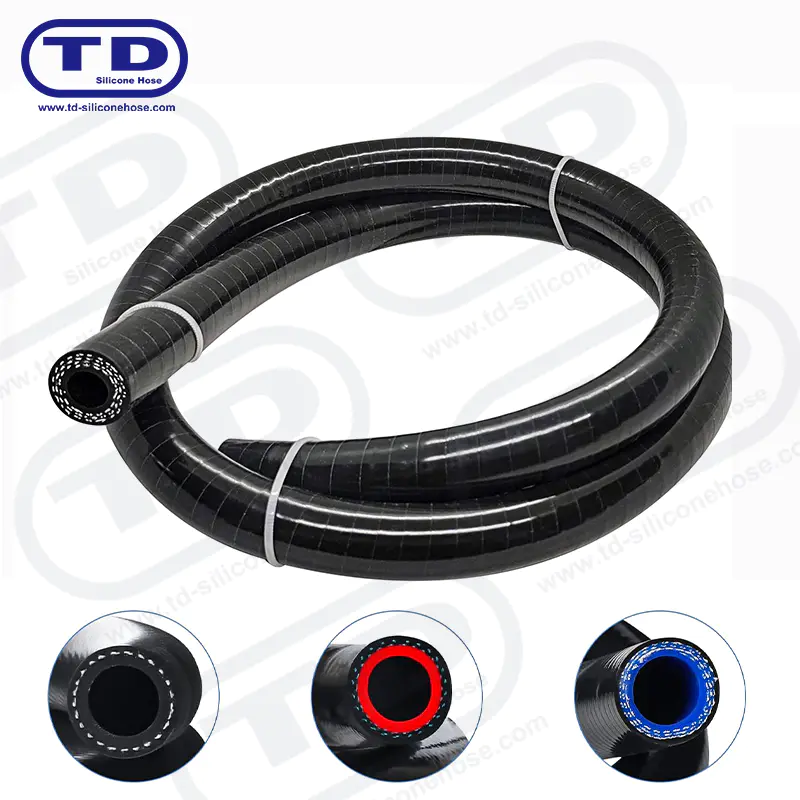
Silicone on its own is a relatively soft material. What gives a hose its pressure rating isn't the silicone — it's what's woven inside it. A performance silicone hose is typically constructed from multiple plies of silicone compound reinforced with polyester or aramid fibre braid between layers.
Standard-Duty (2–3 Ply)
For most street-driven vehicles, a 3-ply reinforced hose rated between -60°C and +180°C fits standard cooling systems without compatibility risks. This covers the majority of coolant, heater, and induction hose applications.
Heavy-Duty / Motorsport (3–4 Ply)
High-end motorsport hoses may use three or four reinforcement plies to achieve pressure ratings above 4 bar, suited to boosted engines, intercooler piping, and applications with sustained high internal pressure.
The construction principle: the reinforcement determines the pressure rating; the material determines the chemical and thermal resistance. A hose with excellent temperature specs but only single-ply construction will still fail under boost pressure it was never built to hold — the two properties are independent and both need to match the application.
Where Silicone Cannot Replace Rubber: The Oil and Fuel Exception
This is the single most important limitation to understand before specifying silicone hose, and it applies regardless of temperature rating.
Critical compatibility warning: The molecular structure of silicone doesn't play well with oil, fuel, and other oil-based products. Any application where the hose contacts engine oil, hydraulic fluid, or fuel demands a different material entirely — standard silicone will swell, soften, and degrade on contact with petroleum-based fluids, the same failure mode rubber engineers specifically avoid EPDM for.
For coolant, heater core, induction, intercooler, and vacuum lines — where the fluid is water/glycol coolant or air — standard silicone is the correct material. For fuel lines, oil coolers, or PCV routing, a fluorosilicone or FKM-lined variant is required instead. This is precisely why reinforced silicone hose product lines typically offer both standard and chemically-resistant inner-lining options rather than a single formulation for everything.
Silicone Hose in Hydrogen Fuel Cell Systems: A Different Set of Demands
Hydrogen fuel cell vehicle (FCV) applications push silicone hose requirements well past standard automotive cooling duty, for one specific reason: hydrogen's molecule is extremely small. Hydrogen's small molecular size makes permeation one of the main challenges in fluid transfer — hoses must help minimize gas diffusion and reduce leakage risks.
This changes what "quality" means for a fuel cell hose. It's no longer just about temperature and pressure — purity and permeation resistance become equally critical:
- Curing method matters for contamination control: platinum-cured silicone offers ultra-high purity with minimal extractables and leachables, and is preferred for critical fluid paths and fuel cell systems where contamination must be minimized — versus standard peroxide-cured silicone, which may release by-products during curing, increasing the risk of leaching.
- Low-extractable formulations protect sensitive components: silicone hoses are available with low levels of extractables — chemicals that can migrate from a material because of extreme temperatures — since contaminants from a hose material can affect the performance and durability of a hydrogen fuel cell.
- FKM linings address the toughest cooling-circuit demands: an FKM lining developed specifically for cooling circuits in fuel cell applications maintains an extremely low proportion of volatile compounds at operating temperature to prevent interference with sensors and membranes within the fuel cell.
- Reinforcement still applies the same way: fuel cell hoses are reinforced with 2, 3, or 4 ply depending on specific system needs, following the same construction logic as conventional automotive silicone hose.
The practical implication for buyers: a general-purpose silicone hose and a fuel-cell-grade silicone hose can look nearly identical while performing very differently in a hydrogen system. The curing process and extractables profile — not just the visible construction — is what determines whether a hose is genuinely suited to FCV cooling circuits, anode lines, or cathode lines.
Reading a Silicone Hose Spec Sheet: What Each Number Tells You
When comparing hoses across suppliers, four specifications actually matter — everything else is secondary.
| Spec | What to Check | Why It Matters |
|---|---|---|
| Temperature range | Must cover your climate and under-hood peak, not just ambient | Must cover your climate extremes to avoid compatibility risk |
| Ply count | 2–3 ply for street use; 3–4 ply for boosted or high-pressure systems | Determines actual pressure-holding capability, independent of temperature rating |
| Wall thickness | 4–5 mm standard; 5–6 mm for high-boost intercooler piping | Thin walls on budget hoses lead to early swelling under pressure cycling |
| Reinforcement fiber type | Polyester (standard), aramid/glass fiber (heavy-duty) | Aramid and glass fiber reinforcement raise the achievable pressure and temperature ceiling |
Sizing and Fit: The Details That Prevent Leaks
Even a correctly specified hose fails if it's the wrong physical fit. A few sizing principles apply consistently across automotive silicone hose applications.
- Measure the pipe OD with calipers, not a ruler — common automotive pipe sizes run 19, 25, 32, 38, 45, 51, 57, 63, 70, 76, and 89 mm.
- A 1–2mm undersize ID is fine — the hose stretches slightly over the pipe, but oversize leads to leaks under clamp.
- Match the elbow angle to the actual routing path — a 90° elbow is not a substitute for a 135° elbow; forcing a hose into the wrong angle introduces stress that accelerates joint failure.
- Use constant-tension clamps, not standard worm-gear clamps, since silicone's slightly different compression behavior compared to rubber benefits from clamps designed to maintain consistent pressure through heat cycling.
Why the Higher Upfront Cost Often Pays for Itself
Silicone hose costs two to five times more upfront than a comparable rubber hose — a real consideration for fleet or bulk purchasing. But the cost comparison changes when you look past the purchase price.
Rubber hoses become brittle and prone to failure over time, often needing replacement every few years, while silicone's superior resistance to heat aging means it remains flexible and resilient for a much longer lifespan, often outlasting the vehicle itself. Because silicone lasts years longer and prevents overheating failures, it often costs less per year of service — which is the calculation that matters for fleet operators, performance shops, and anyone specifying hose for equipment expected to stay in service for a decade or more.
Practical replacement guidance: Even though silicone resists degradation far better than rubber, it does still age. Replace silicone hose every 5–7 years regardless of appearance, and always buy from suppliers with published pressure and temperature specs rather than unlabeled generic listings, since cheap hoses often use thin silicone with poor reinforcement that won't hold to its stated rating.
Bottom Line
Automotive silicone hose isn't a premium alternative to rubber for its own sake — it solves a specific problem rubber physically cannot: sustained performance across a temperature range nearly 100°C wider, without the hardening, cracking, and ozone degradation that limits rubber's service life under the hood. The ply count and reinforcement fiber determine what pressure it can hold; the curing method and lining determine whether it's suited to standard coolant duty or the tighter purity demands of a hydrogen fuel cell circuit. Match those specifications to your actual application — temperature, pressure, and fluid contact — and a properly specified silicone hose will reliably outlast the vehicle components around it.
Our Product //
Ningbo Tiandai Auto Parts Co., Ltd. All Rights Reserved. ALL RESERVED.
Wholesale Automotive Silicone Hose Manufacturers
