

 English
 中文简体
中文简体 русский
 Español
 عربى
عربى
Submit feedback
From Raw Silicone to Performance Hoses: The Complete Manufacturing Process Explained
Industry news-Content
- 1 1. Raw Material Compounding – Building the Base Formula
- 2 2. Preforming – Turning Compound into Workable Sheets or Tubes
- 3 3. Mandrel Wrapping – Building the Hose Shape Layer by Layer
- 4 4. Curing – Setting the Crosslinks
- 5 5. Demoulding, Finishing, and Post-Cure Operations
- 6 6. Quality Control – The Gate Before Shipping
- 7 7. Extrusion Alternative – A Faster, Longer Production Method
- 8 8. Application-Specific Considerations During Manufacturing
- 9 Conclusion – The Precision Behind Every Silicone Hose
Pop the hood of a turbocharged engine or walk through a race paddock, and you will see silicone hoses in bright blue, red, or black. They connect radiators, intercoolers, and intake systems, surviving constant heat, vibration, and pressure. But the silicone hose you buy off the shelf starts its life as a dense, unassuming brick of raw material. The process that turns that brick into a precision-engineered component is methodical and tightly controlled. Silicone hoses are made through five core stages: raw material compounding, preforming, mandrel wrapping (for shaped hoses), curing under heat and pressure, and finishing with quality checks. Each stage directly determines the hose’s performance in your vehicle or machine.
1. Raw Material Compounding – Building the Base Formula
Every silicone hose begins with silicone polymer—a synthetic rubber based on silicon-oxygen chains. Manufacturers purchase it in solid blocks, often called “bricks,” weighing roughly 30 pounds each. These bricks go into an internal mixer (a Banbury or kneader) together with reinforcing fillers (fumed silica for tear strength), heat stabilizers (iron oxide or cerium oxide for long-term thermal resistance), vulcanizing agents (peroxides for crosslinking), and color pigments. The mixer blends them under controlled temperature until a homogenous, dough-like compound is formed. The quality of this mix dictates the hose’s ultimate tolerance to temperature, pressure, and chemical attack. Any inconsistency in dispersion creates weak points. Manufacturers certified to IATF 16949, like Ningbo Tiandai Auto Parts, implement strict batch control to ensure repeatable compound properties.
2. Preforming – Turning Compound into Workable Sheets or Tubes
Once mixed, the compound is dumped onto a mill to be sheeted out. A two-roll mill further kneads it into a continuous sheet of controlled thickness, typically 1–3 mm for hose construction. Alternatively, the compound may be fed into an extruder to produce a continuous tube profile—this extrusion method is often used for straight, constant-diameter silicone hoses. The extruded tube is cut to length and set aside for the wrapping stage. For more complex shapes, the sheeted material is cut into strips of specific width; these strips will later be hand-wrapped around mandrels. The preforming step ensures the material has the right geometry to be efficiently formed in the next operation.
3. Mandrel Wrapping – Building the Hose Shape Layer by Layer
This is the heart of high-performance silicone hose manufacturing. A polished stainless steel mandrel, machined to the exact internal diameter and bend radius of the desired hose, is mounted on a lathe or held in a fixture. The operator applies a thin layer of chalk dust or release agent to the mandrel to prevent sticking. Then, using the pre-cut silicone strips, they wrap the uncured compound around the mandrel, overlapping each wrap by roughly 50% of the strip width. The number of layers determines the finished wall thickness and burst strength—a typical 4-ply hose for automotive coolant uses four overlapping layers, while heavy-duty applications may use 5 or 6. The strip tension and overlap angle must be consistent; otherwise, the hose will exhibit weak seams or uneven wall thickness. After wrapping, the assembly is encased in a tightly wound nylon or cotton tape. This tape applies uniform radial pressure during curing and prevents the layers from separating. For tight-radius elbows, a single continuous strip may be supplemented with darts (cuts) on the inner radius to avoid wrinkling.
This mandrel-wrapping technique is the standard method for producing silicone elbow hoses, reducers, humps, and T-shaped connectors. For example, a 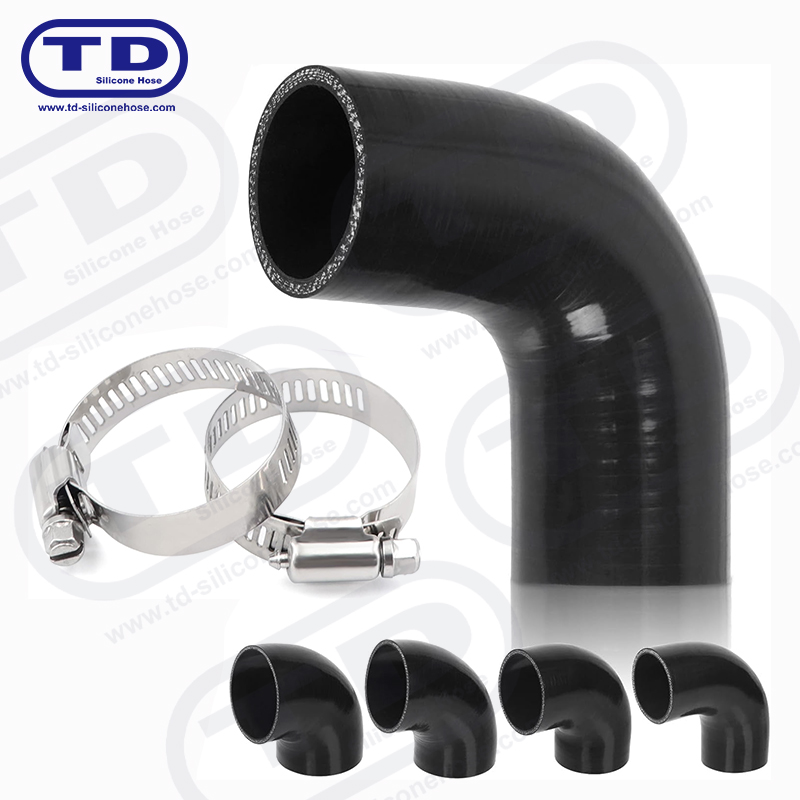 Silicone 90° Elbow Hose for Mandrel WrappingThis formed hose is a prime example of mandrel-wrapped construction, offering precise bends and internal reinforcement for tight routing in automotive cooling systems.View Product → (90° elbow hose) relies on a precisely curved mandrel to achieve its signature bend without collapsing the inner diameter.
4. Curing – Setting the Crosslinks
The taped mandrel assemblies are loaded into a steam autoclave or a hot-air oven. Curing takes place at temperatures between 325 °F and 380 °F (163 °C–193 °C) for 15 to 40 minutes, depending on wall thickness and compound formulation. The heat activates the peroxide or platinum catalyst, which creates crosslinks between the silicone polymer chains. This transforms the soft, putty-like compound into a resilient, thermoset elastomer. The pressure from the autoclave and the constriction of the wrapping tape push the layers together, eliminating voids and ensuring dimensional accuracy. After curing is complete, the assemblies are cooled gradually to room temperature to avoid thermal shock and distortion. The tape is then stripped off, and the mandrel is removed—either by hand or with a pneumatic press—leaving a fully formed silicone hose.
During curing, the hose must not be overheated or underheated; insufficient crosslinking leads to poor mechanical properties and premature failure, while excessive heat can degrade the polymer. Reputable manufacturers maintain tight time-temperature profiles and chart every batch. This is particularly critical for 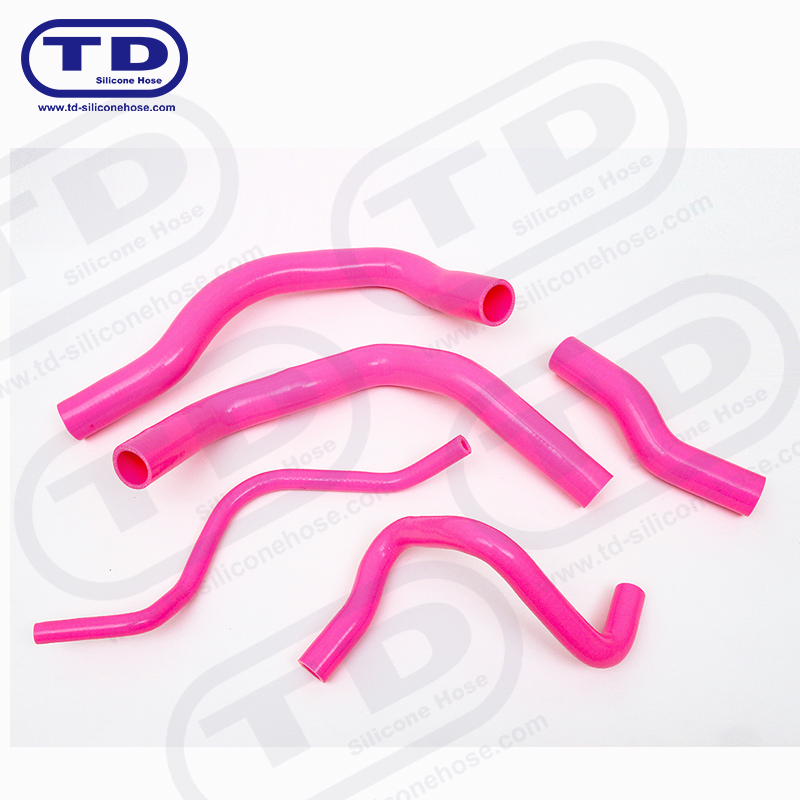 Car Silicone Radiator Hose Kits for Engine CoolingPost-cure treatment enhances heat and pressure resistance, making these hoses reliable for continuous coolant service up to 300°F in diverse vehicle applications.View Product → (car silicone radiator hoses), which must withstand continuous coolant temperatures up to 300 °F (150 °C) and pressure spikes from the cooling system.
5. Demoulding, Finishing, and Post-Cure Operations
Once demoulded, the raw hose has a rough outer surface from the tape imprint, plus flash (excess rubber) at the ends. Operators trim the flash using a lathe or a sharp knife. For hoses that require a smooth exterior, the outer surface may be lightly buffed or ground—though many performance hoses keep the textured finish for better clamp grip. If the hose includes a reinforcement layer, such as embedded wire or fabric, that layer must be introduced during the wrapping step (by placing a braided sleeve over the compound before the final overwrap). After demoulding, a secondary post-cure (oven baking for 1–4 hours at 390 °F/200 °C) is sometimes performed to volatilize low-molecular-weight siloxanes, improving compression set resistance and reducing outgassing.
6. Quality Control – The Gate Before Shipping
No hose leaves a professional factory without passing a battery of tests. The most common checks include:
| Test | Purpose | Typical Acceptance |
|---|---|---|
| Dimensional inspection | Verify ID, OD, wall thickness, and bend radius | ±0.5 mm on ID |
| Burst pressure | Confirm maximum operating pressure | 3–10 bar depending on type |
| Heat aging | Check degradation after 168 h at rated temp | No cracking, elongation drop < 30% |
| Hardness (Shore A) | Ensure consistent material stiffness | 60–70 A typical |
| Visual inspection | Check for blisters, inclusions, or delamination | Zero defects |
Manufacturers with IATF 16949 certification, such as Ningbo Tiandai, maintain traceability from batch number to final hose, enabling root-cause analysis if a field failure occurs. The final product is then packaged with proper labeling and shipped. For extreme environments, such as turbocharger intake or hydrogen fuel cell systems, additional validation like ozone resistance or permeation tests may be required.
For a deeper dive into the step-by-step factory procedure, refer to our full guide on how to make silicone hoses.
7. Extrusion Alternative – A Faster, Longer Production Method
Not all silicone hoses are mandrel-wrapped. Straight silicone hoses of constant cross-section can be produced by continuous extrusion. In this process, a screw extruder forces the silicone compound through a die that shapes the tube profile. The extruded tube is immediately vulcanized in a hot-air tunnel or a salt bath (for fluorosilicone). Extrusion is significantly faster than mandrel wrapping and ideal for long runs of uniform hose, such as vacuum lines or meter hose. However, it cannot produce complex bends or reducers. The extruded hoses are then cut to length, finished, and tested. Our 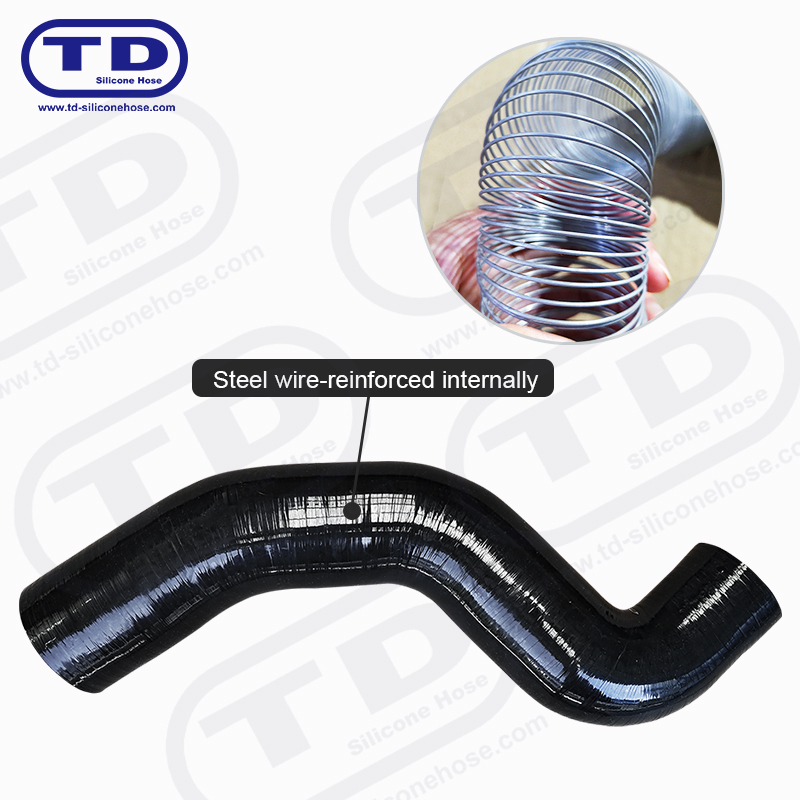 Wire Reinforced Silicone Hose for High PressureCombining extrusion with embedded steel wire, this hose resists collapse under vacuum and maintains flexibility in demanding industrial and automotive fluid systems.View Product → (wire-reinforced silicone hose) often starts as an extruded tube onto which a wire helix is wrapped, then covered with another silicone layer and cured.
8. Application-Specific Considerations During Manufacturing
The intended use of a silicone hose dictates many choices in the factory. For example:
- Automotive radiator hoses require thicker walls and multiple fabric-reinforced plies to handle coolant pressure and abrasion from constant movement.
- Intercooler/CAC hoses need higher burst strength (often up to 10 bar) and lower permeation to avoid charge-air leakage.
- Food-grade or medical silicone hoses must be made with platinum-cured silicone and require a clean-room environment with no plasticizers or toxic additives.
- Hydrogen fuel cell hoses demand extremely low outgassing and high purity, achieved by post-curing and using special lining materials.
Each application may also require different surface finishes: a matte texture for race cars that want a non-glare appearance, or an aluminum-wrapped layer for heat reflection near turbochargers. Manufacturers must adjust the wrapping pattern, compound additives, and curing cycle accordingly.
Conclusion – The Precision Behind Every Silicone Hose
Making a silicone hose is far from simple mixing and molding. It is a sequence of precisely controlled operations—compound science, manual layup skills, thermal engineering, and rigorous inspection. The result is a flexible, durable tube that outperforms rubber in extreme conditions. Whether you are choosing a Car Silicone Radiator Hose Kits for Engine CoolingPost-cure treatment enhances heat and pressure resistance, making these hoses reliable for continuous coolant service up to 300°F in diverse vehicle applications.View Product → for your street car or a wire-reinforced hose for a turbo application, understanding the manufacturing process helps you appreciate the quality and select the right product for your needs.
Our Product //
Ningbo Tiandai Auto Parts Co., Ltd. All Rights Reserved. ALL RESERVED.
Wholesale Automotive Silicone Hose Manufacturers
