

 English
 中文简体
中文简体 русский
 Español
 عربى
عربى
Submit feedback
T-Shape Silicone Hose Explained: Sizing, Applications, and Selection Guide
Industry news-Content
A cooling system often needs to send one stream of coolant in two directions—one toward the heater core, another toward the expansion tank. The component that handles this job quietly, without adding extra joints, is a T-shape silicone hose. Instead of assembling a metal tee with three separate rubber hoses, you can use one molded silicone part that fits directly over the three pipes. The result is a cleaner installation, fewer clamps, and fewer places for a leak to develop.
What Is a T-Shape Silicone Hose?
A T-shape silicone hose is a one-piece silicone tube with three openings arranged in the shape of the letter T. In most automotive and industrial layouts, the main port connects to the fluid source, while the two opposing branch ports feed separate circuits. The same geometry can also be reversed, combining two flows into one outlet. Because the junction is molded rather than spliced, the hose has a continuous inner surface at the intersection, which helps maintain flow and reduces the chance of trapped debris.
Silicone is the material of choice for this application because it stays flexible over a wide temperature range, resists coolant and oil byproducts, and returns to its original shape after bending. Typical automotive-grade silicone hoses have a working temperature of about -60°C to 200°C and a wall thickness that provides enough strength under vacuum and pressure. The T-shape is available with equal port sizes or with a smaller branch, depending on the flow split you need.
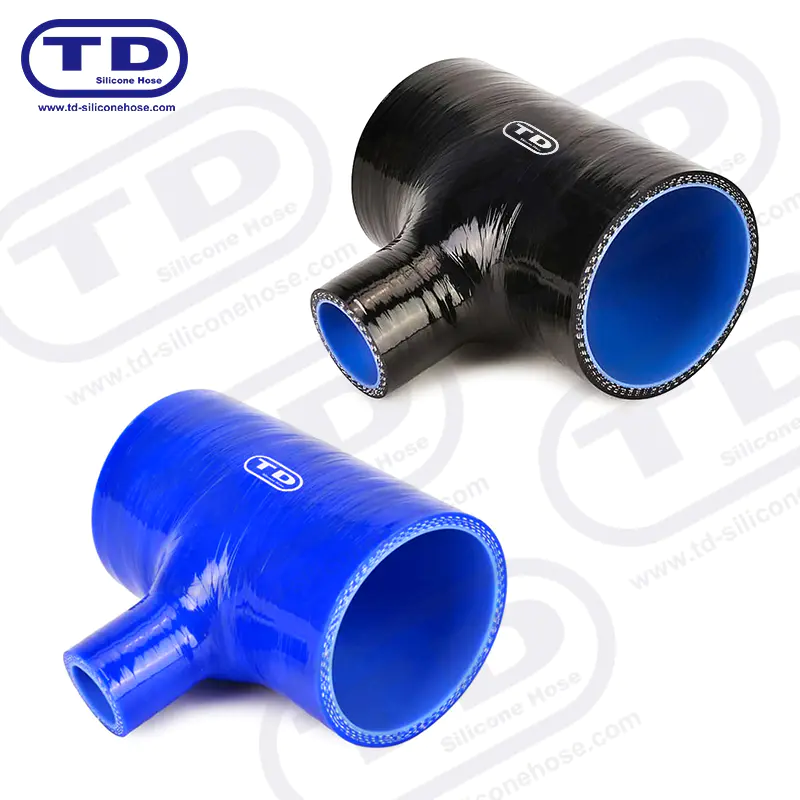 Reinforced Silicone T-Piece Hose for Automotive Cooling and Intake SystemsThis one-piece T-shaped silicone hose reduces connection points compared to a metal tee, minimizing leak paths and simplifying installation. It handles temperatures from -50°C to 250°C and offers reinforced plies for durability.View Product →
Why Use a One-Piece T-Shape Instead of a Separate Fitting?
The biggest advantage of a molded T-hose is reliability. A conventional metal tee requires a short piece of hose between the tee and each system pipe, which means six hose ends and six clamps are exposed to vibration, heat, and possible misalignment. A one-piece T-shape silicone hose connects the system with only three hose ends. Fewer joints mean fewer leak paths and a shorter installation time.
The molded junction also behaves better under pressure. It flexes as the engine moves, rather than transmitting stress into a rigid metal fitting. That flexibility makes a real difference on modified cars and race vehicles, where engine bay temperatures and vibration levels are high.
| Hose Shape | Primary Use | Typical Ports | Main Limitation |
|---|---|---|---|
| Straight hose | Inline connection | 2 | No branching |
| 90-degree elbow | Direction change | 2 | Limited to one turn |
| Reducer hose | Diameter transition | 2 | No branching |
| T-shape hose | Split or combine flow | 3 | Requires careful branch orientation |
How to Choose the Right T-Shape Silicone Hose
Start by measuring the outside diameter of the pipe stubs that the hose will slide over. Silicone hose size markings generally refer to the inner diameter of the hose itself, not the pipe outside diameter. A quality hose is typically manufactured with a nominal inner diameter that is a few tenths of a millimeter smaller than the mating pipe, creating a slight interference fit when installed. If in doubt, ask the manufacturer for a sizing chart rather than guessing.
Branch Spacing and Orientation
The distance between the branch outlet and the main port must match the physical layout of your system. A T-hose with too short a center-to-center distance will put stress on the connections after installation. Measure the actual pipe positions before ordering, especially on custom builds where the hoses follow a particular path.
Temperature, Pressure, and Fluid Compatibility
Engine coolant in a modern vehicle can run above 100°C, and under heat soak the local temperature around the hoses can be much higher. Choose a hose rated for at least 180°C continuous service for cooling and charge-air circuits. For applications that carry oil, fuel vapor, or aggressive chemicals, a fluorosilicone-lined hose adds the required chemical resistance. If the hose will see vacuum or higher pressure, a wire-reinforced T-shape is a safer choice.
Quality and Certification
Because a molded T-junction is more complex to manufacture than a straight hose, consistency at the mold parting line matters. A supplier with an IATF 16949 quality system is more likely to maintain tight wall thickness and clean inner surfaces. Check the construction details as well: a typical reinforced silicone hose has multiple plies of knitted or woven polyester to provide burst strength and dimensional stability.
- Measure each pipe outside diameter and match the nominal hose ID.
- Confirm the distance between the branch and the main port.
- Choose a wall thickness suited to the system pressure.
- Verify the temperature range against the hottest point in the hose run.
- Check the fluid compatibility, especially for oil or fuel exposure.
Common Applications for T-Shape Silicone Hoses
T-shape silicone hoses appear in engine cooling circuits, heater systems, crankcase ventilation, and charge-air cooling systems. On a modified car, they are often used to connect a coolant overflow tank to the radiator and heater circuit, or to run a vacuum line to a boost controller. On trucks and buses, the same hose helps distribute coolant to auxiliary heaters and cabin heaters without adding rigid fittings.
- Coolant branch lines on engine cooling systems
- Heater core inlet and outlet plumbing
- PCV and crankcase breather circuits
- Turbocharger vacuum and boost signal lines
- Hydrogen fuel cell coolant and gas lines
For a closer look at how the T-shaped design improves real-world installation flexibility, see this overview of T-shaped design benefits.
Installation and Fitting Tips
Before sliding a T-shape hose into position, make sure the pipe ends are clean and free of burrs. A light film of soapy water or silicone grease on the inside of the hose makes assembly easier and reduces the chance of tearing the reinforcement. Slide the main port onto the pipe first, then align the two branch ports. If the hose fights back, avoid forcing it; check that the orientation and length are correct.
Use the right clamp for the size. Small-diameter branches can use standard spring or worm-gear clamps, but large ports—typically above 40 mm—benefit from a T-bolt clamp because it applies even pressure around the full circumference. The reinforced edge of the silicone hose should be positioned in the clamp band before the clamp is tightened.
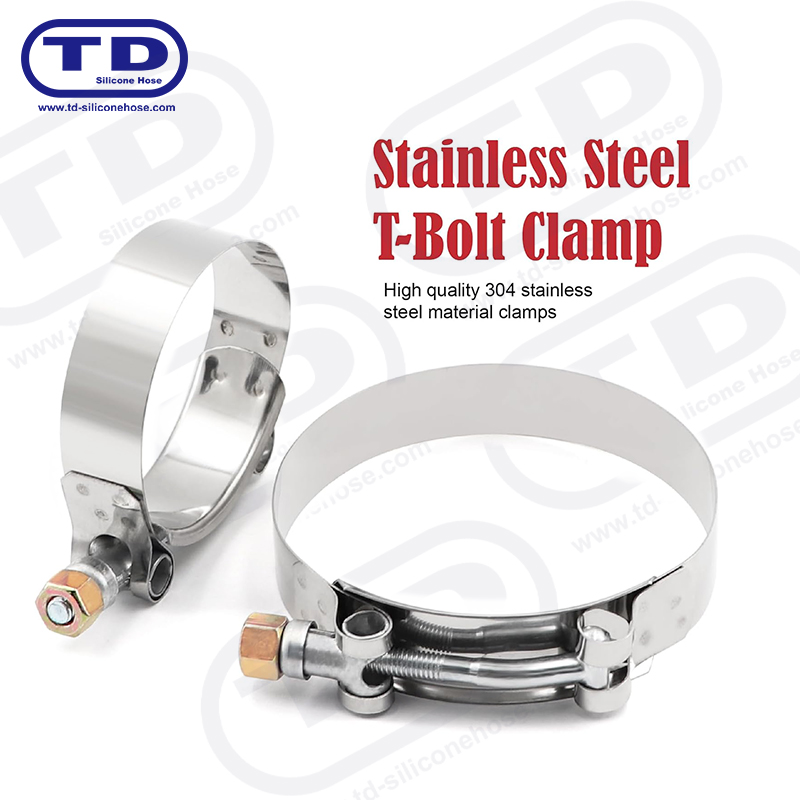 Heavy-Duty SUS304 Stainless Steel T-Bolt Hose Clamp for Large-Diameter Silicone HosesDesigned for ports above 40 mm, this T-bolt clamp distributes even pressure around the hose circumference, preventing leaks under vibration and temperature changes. Constructed from high-grade stainless steel for long-lasting performance.View Product →
After tightening, rotate the hose slightly and check for any twist. A twisted T-shape can put uneven tension on the branch ports. Also confirm that the hose does not rub against brackets, pulleys, or hot manifold surfaces. For high-heat areas, a reflective sleeve or aluminum-wrapped silicone hose adds protection.
Sourcing T-Shape Silicone Hoses from a Specialist Manufacturer
Not every silicone hose producer handles T-shape moulding well. The junction requires precise tooling and a stable production process to keep the wall thickness consistent. When sourcing for a fleet, a workshop, or a new vehicle program, look for a manufacturer with a dedicated silicone hose range and a quality certification such as IATF 16949. Ningbo Tiandai Auto Parts Co., Ltd. is one example: the company produces T-shape silicone hoses as part of its universal silicone hose tube line, alongside reducers, elbows, and straight hoses. Its factory in Ningbo, China, supports standard sizes from approximately 10 mm to 120 mm, with custom dimensions and color options available.
Pairing the hose with the correct clamp and fitting completes the system. A supplier that also offers aluminium fittings and a range of clamping styles simplifies procurement and ensures component compatibility. For buyers outside China, attention to packaging and shipping matters as well, since silicone hoses are flexible but should still be protected from sharp objects during transit.
The bottom line is simple: measure the pipes correctly, specify the temperature and media, and choose a one-piece T-shape silicone hose from a maker with proven quality control. You will end up with a junction that is easier to install, simpler to maintain, and more durable under heat and vibration.
Our Product //
Ningbo Tiandai Auto Parts Co., Ltd. All Rights Reserved. ALL RESERVED.
Wholesale Automotive Silicone Hose Manufacturers
